THE MOST INTERESTING PART OF PROJECT MASTER IS THE PART YOU CAN'T SEE
Before being reborn as Project MASTER, Ocean Ness was built to operate in one of the most demanding working environments on earth: the North Sea.

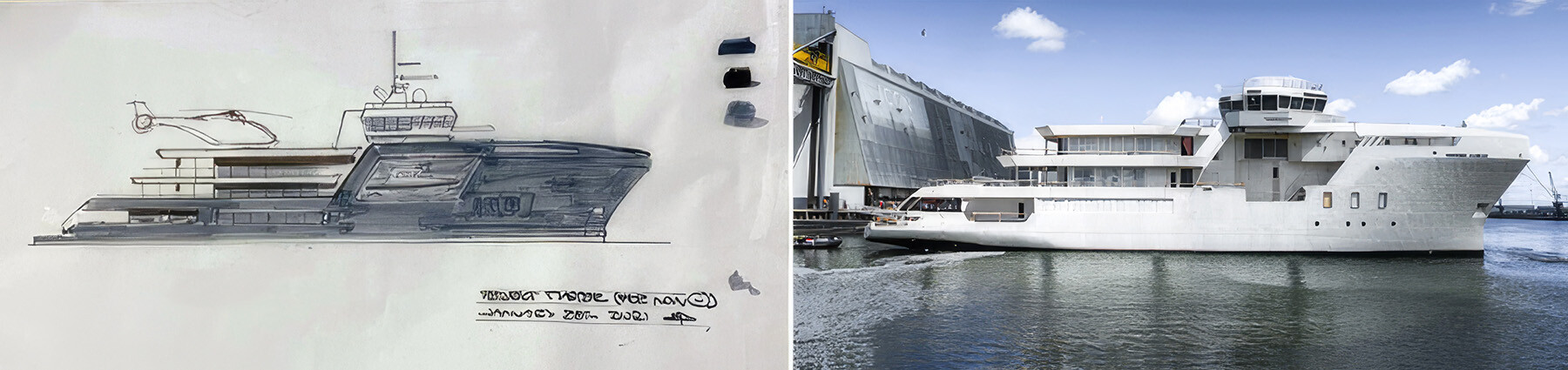
Her story is rooted in the evolution of offshore rescue vessels, the lessons of Piper Alpha and the Cullen Inquiry, as well as the pioneering UT vessel designs developed by Ulstein for extreme-weather operations.
That history is central to understanding Project MASTER.
As an Emergency Response and Rescue Vessel (ERRV), Ocean Ness was designed around the demands of the North Sea. Her deep forefoot, high freeboard, substantial scantlings, reserve buoyancy, damage survivability and exceptional storage capacity were not features added for a yacht brief. They were requirements shaped by an unforgiving offshore environment.
These same qualities now provide an unusually strong platform for an exploration yacht. The vessel’s original design offers the strength, endurance and resilience required for long-range exploration, while providing the foundations for her transformation into Project MASTER.
To understand what makes Project MASTER so distinctive, we have gone back to the beginning.
The Platform explores where Ocean Ness came from, why she was built the way she was and why the qualities developed for North Sea operations remain so relevant to exploration yachting today.
For anyone interested in yacht design, naval architecture, offshore engineering or the history of exploration vessels, it is a story worth reading.